



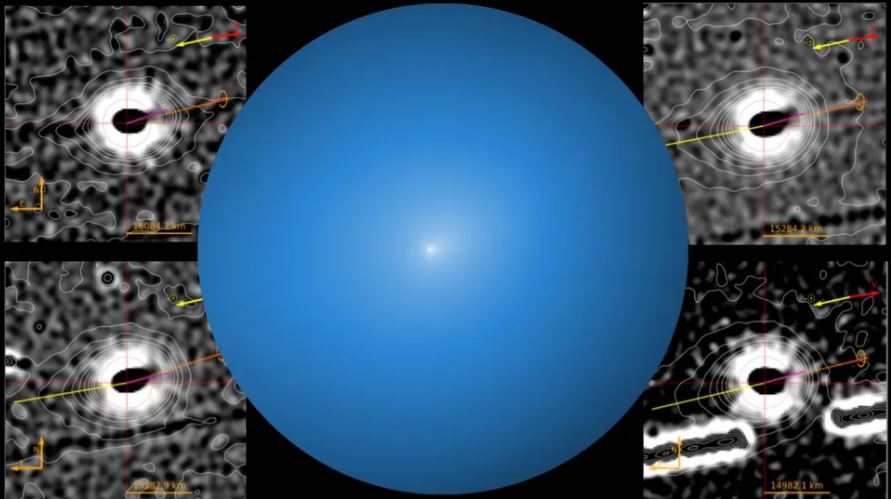
The third confirmed interstellar visitor to our solar system continues to surprise astronomers with unprecedented behavior. Comet 3I/ATLAS has displayed jet structures in its unusual sun-facing “anti-tail” that wobble every 7 hours and 45 minutes Space.com — a phenomenon never before observed in an interstellar object.
What Makes This Discovery Special?
Most comets display tails that stream away from the Sun, pushed by solar radiation and solar wind. But 3I/ATLAS sports a rare “anti-tail” pointing directly toward our star, stretching up to 620,000 miles (1 million kilometers) Space.com into space. While this feature has been seen in some solar system comets, the wobbling jets within represent the first time such outgassing activity has been documented from an interstellar visitor.
Key Findings:
Researchers using the Two-meter Twin Telescope in Tenerife monitored the comet across 37 nights between July 2 and September 29, 2025. The wobbling motion revealed that the comet’s nucleus rotates once every 15 hours and 30 minutes Space.com — a shorter period than previously estimated.
The team tracked the comet’s coma as it transformed from a sun-facing dust fan before August into a pronounced antisolar tail. This evolution occurred as 3I/ATLAS approached the sun, coming within 130 million miles (210 million km) on October 30, 2025 Space.com.
Historical Context:
3I/ATLAS joins an elite group of confirmed interstellar visitors: the cigar-shaped ‘Oumuamua (October 2017) and comet 2I/Borisov (August 2019). According to the research team, investigating jets in this pristine body formed in another planetary system represents a unique opportunity to study material from beyond our solar system.
The comet made its closest approach to Earth on December 19, 2025, passing within approximately 168 million miles (270 million kilometers) of our planet.
Image credit: NASA, ESA, STScI, D. Jewitt (UCLA). Processing: J. DePasquale (STScI)/ Serra-Ricart, Licandro, and Alarcon


