


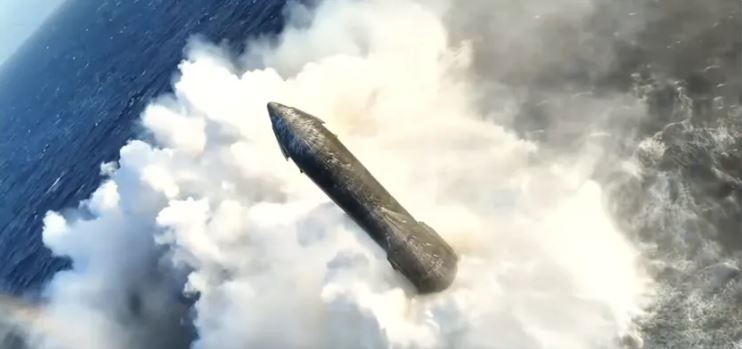
Starship completed its thirteenth flight test with its smoothest splashdown ever. During the mission, SpaceX also released the next-generation Starlink satellites from a Starship for the first time.
The launch took place on July 24, 2026, at 5:51 PM local time from Starbase, Texas. Flight 13 was the second flight of the Starship and Super Heavy V3 vehicles and was intended to verify several capabilities necessary for future orbital missions.
Nominal Flight and Release of 20 Starlink V3 Satellites
After firing the Super Heavy’s 33 Raptor 3 engines, the system completed the first phase of ascent and the hot staging maneuver. Starship then continued its flight using its six Raptor engines, reaching its target speed and trajectory.
One of the mission’s key achievements was the release of 20 Starlink V3 satellites. SpaceX reported that it had established radio and laser links with all the satellites, acquiring telemetry data before their scheduled reentry into the atmosphere approximately 20 minutes after deployment.
The test was therefore not a normal operational Starlink mission, but a comprehensive demonstration of the new delivery system.
Reignition of a Raptor in Space
During the flight, Starship also successfully reignited a single Raptor engine in space. This is an essential capability for future orbital missions because it allows the spacecraft to alter its trajectory and perform a controlled reentry maneuver.
During descent, the spacecraft collected additional data on the behavior of its heat shield and performed a dynamic turning maneuver. The test was designed to simulate part of the expected profile for future reentries to Starbase.
Starship remains intact after splashdown
Guided by its four aerodynamic surfaces, Starship reached its designated landing site in the Indian Ocean. The spacecraft then reignited its three central Raptor engines, executing the rotation maneuver, final braking, and a soft splashdown.
After entering the water, Starship flipped over and continued to float with its belly facing up. The vehicle remained intact and communicating, allowing for the first close-up observation of the heat shield of a Starship that survived reentry and splashdown.
SpaceX called the event the softest splashdown ever achieved by Starship in the Indian Ocean. Images transmitted by a drone showed the vehicle still floating at the end of the mission.


