



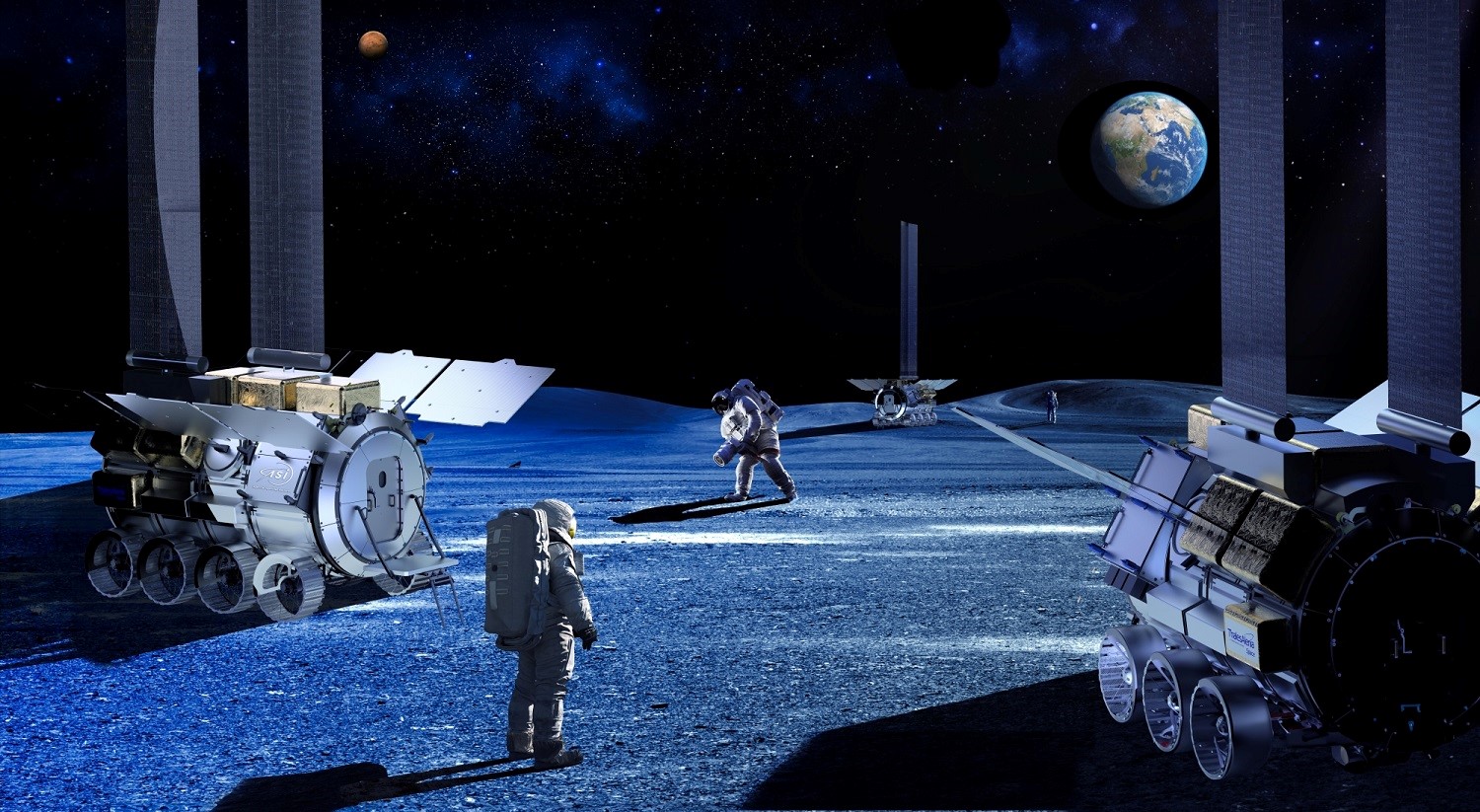
Major milestone announced for international Moon exploration as Italian Space Agency contracts Thales Alenia Space for revolutionary Multi-Purpose Habitation module
The Italian Space Agency (ASI) has awarded a significant contract to Thales Alenia Space to design what will become humanity’s first dedicated living quarters on the lunar surface. The Multi-Purpose Habitation (MPH) module represents a crucial component of the broader Artemis collaboration between NASA and Italy.
A Mobile Home on the Moon
Set for launch in 2033 from Kennedy Space Center, the MPH module breaks new ground by combining the functions of both a mobile rover and a permanent habitat. This dual-purpose design will allow the structure to relocate across the lunar surface while providing long-term accommodation for astronaut crews.
The habitat is engineered for an operational lifetime of at least 10 years, during which it will support multiple mission objectives including crew habitation, scientific research activities, and surface operations. Notably, the module will be capable of conducting experiments both with astronauts present and during autonomous periods.
Engineering for Extreme Conditions
The two-year preliminary design phase will tackle some of the Moon’s most challenging environmental factors. The engineering consortium, led by Thales Alenia Space Italy and including Altec along with other Italian industrial partners, must develop solutions for:
- Dramatic temperature swings between lunar day and night
- Abrasive lunar regolith that can damage equipment and pose health risks
- Intense radiation exposure without Earth’s protective magnetosphere
- Micrometeoroid bombardment
- Effects of one-sixth Earth gravity on systems and human physiology
Strategic Importance for Italy
ASI President Teodoro Valente highlighted the strategic significance of the project, noting it positions Italy as a central player in the Moon-to-Mars exploration roadmap. The timing is particularly noteworthy, coming just days after Italy’s parliament approved the country’s first comprehensive space law.
The MPH contract leverages Thales Alenia Space’s extensive experience in space habitability systems and represents a continuation of the long-standing NASA-ASI partnership. For Italy, this project demonstrates the country’s commitment to maintaining and expanding its role in the evolving space economy.
Looking Beyond the Moon
While the immediate focus remains on lunar surface operations, the technologies developed for the MPH module will inform future human missions to Mars. The expertise gained in creating sustainable habitation systems for the harsh lunar environment will prove invaluable for the even more challenging journey to the Red Planet.
Giampiero Di Paolo, Deputy CEO at Thales Alenia Space, emphasized the broader implications of the project, describing it as an opportunity to advance human space exploration capabilities that will benefit missions to the Moon and beyond.
Integration with Artemis Architecture
The MPH module is designed to function synergistically with other elements of the Artemis program infrastructure. This interoperability will be essential for creating a cohesive and efficient lunar surface operations network, supporting the program’s goal of establishing a sustained human presence on the Moon.
As the 2033 launch date approaches, the international space community will be watching closely to see how this Italian-led initiative shapes the future of human habitation beyond Earth.


