


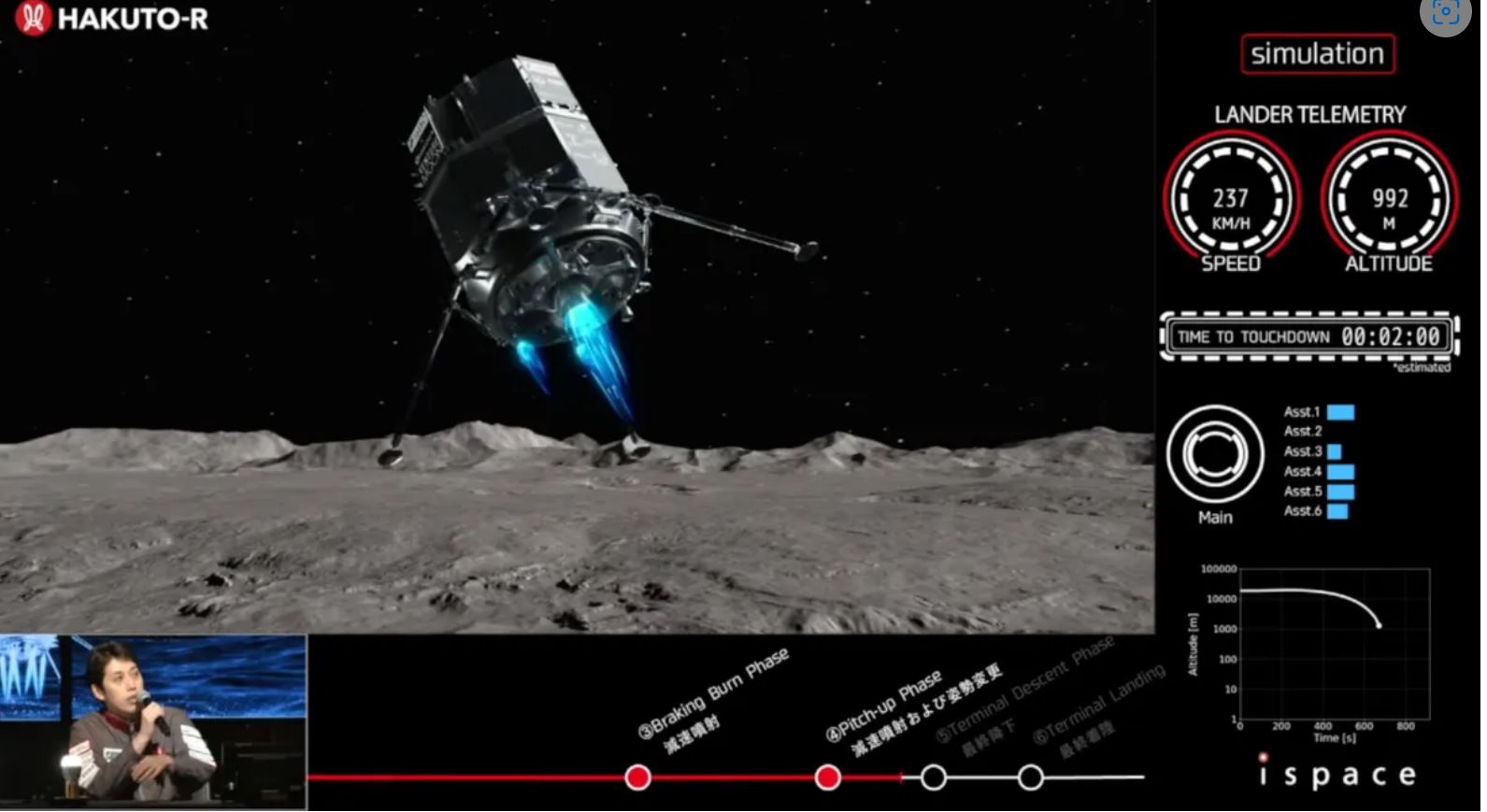
In another bold attempt to make space history, Japanese startup ispace has confirmed that its Resilience spacecraft crash-landed on the Moon during a highly anticipated landing attempt on June 5, 2025. The spacecraft went silent just under two minutes before touchdown, likely the result of a technical malfunction that caused it to descend too rapidly.
A Second Attempt, A Second Setback
Resilience was intended to be the first privately-built Japanese lander to softly touch down on the lunar surface. Targeting the Mare Frigoris, or “Sea of Cold,” on the Moon’s near side, the mission was set to make a precise landing at 3:17 p.m. EDT (1917 GMT). However, ispace lost contact 1 minute and 45 seconds prior to landing, prompting immediate concern among mission controllers.
At a press conference following the event, ispace founder and CEO Takeshi Hakamada acknowledged the mission’s failure with resolve.
“We wanted to make Mission 2 a success, but unfortunately we were unable to land,” he said.
This outcome mirrors the company’s first mission in April 2023, which ended similarly after telemetry was lost during descent.
Learning From Failure
Despite the disappointment, ispace has reiterated its commitment to lunar exploration. The company views each setback as a crucial learning opportunity in the challenging path toward commercial space activity. These missions are part of a broader roadmap to provide lunar delivery and infrastructure services for governments and private entities.
Notably, ispace is not alone in experiencing the harsh realities of lunar landings. Multiple national and private entities—including Russia’s Luna 25 and India’s Chandrayaan-2—have encountered similar challenges in recent years, illustrating the technical and environmental complexity of soft-landing on the Moon.
Eyes on 2027
Looking ahead, ispace is already preparing for its next mission in 2027, maintaining confidence in its long-term vision. With an iterative approach that values resilience and refinement over immediate success, the company continues to play a central role in Japan’s expanding space ambitions—and in the emerging landscape of private lunar exploration.
A Crucial Moment for the Private Space Race
As global interest in the Moon accelerates, missions like ispace’s Resilience are helping define the new frontier of commercial lunar access. While setbacks are inevitable, they also serve as stepping stones toward sustained operations on the lunar surface. For ispace—and for the wider private sector—this is not an ending, but a recalibration on the journey to the Moon.


