


NASA’s Perseverance rover has just taken a major leap forward in autonomy, and it could change the way we explore Mars forever.
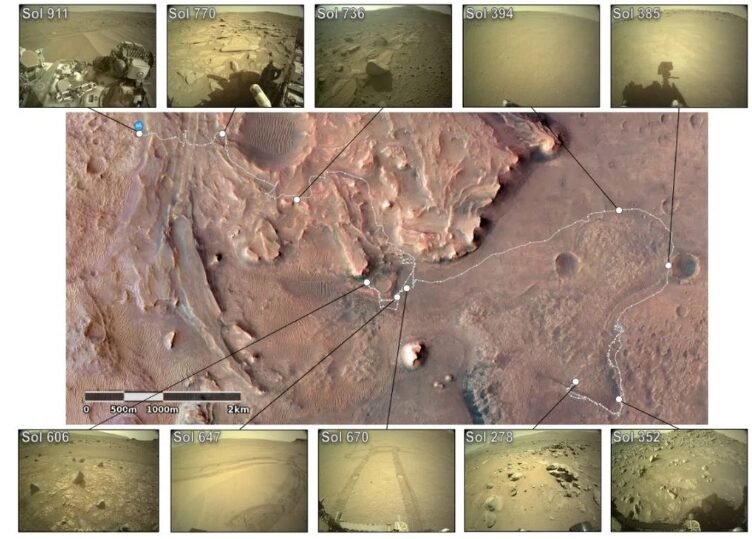
Like its predecessor Curiosity, Perseverance has always had a degree of autonomous navigation through a system called AutoNav. But one stubborn problem has always held it back: the longer the rover drives on its own, the less certain it becomes about its exact position on the Martian surface. When that uncertainty grows too large, the rover essentially stops and waits for human help. Engineers on Earth then manually match its position to a global map before it can continue — a time-consuming process that limits how far Perseverance can roam each day. Its longest autonomous drive to date has been just under 700 meters over three days.
Now, a new system called Mars Global Localization (MGL) is changing the game entirely.
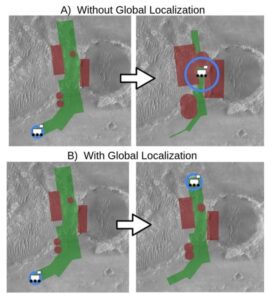
The figure shown above illustrates exactly why this matters. During a long drive through a narrow corridor on Sol 385, you can see how the rover’s position uncertainty (the blue circles) grows over time without MGL, causing the potential hazard footprint to balloon until the rover can no longer safely continue. With MGL active, that error stays under control, hazards remain manageable, and the rover keeps moving — without any human intervention.
The system works by having Perseverance take a 360-degree panoramic image and then using an onboard algorithm to compare it against terrain maps captured by orbiters — specifically matching them to HiRISE images from the Mars Reconnaissance Orbiter. No human needed. The rover can now pinpoint its surface location to within 10 inches, in just about two minutes.
Interestingly, this breakthrough was made possible in part by the end of Ingenuity’s mission. After the helicopter suffered rotor damage in January 2024, the powerful microprocessor previously dedicated to communicating with it became available to run the MGL algorithm.
Perseverance successfully tested the system twice during normal operations — on February 2nd and February 16th — with great results. The potential implications are enormous: the rover could one day cover virtually unlimited distances without waiting for instructions from Earth.
“We’ve given the rover a new ability,” said JPL robotics engineer Jeremy Nash, who led the team. “This has been an open problem in robotics research for decades, and it’s been super exciting to deploy this solution in space for the first time.”
And it doesn’t stop with Perseverance — the authors of the research paper note that MGL could be applied to future planetary robotic missions as well, making it a cornerstone technology for the next generation of Mars exploration. 🚀
Source: NASA JPL-Caltech


